
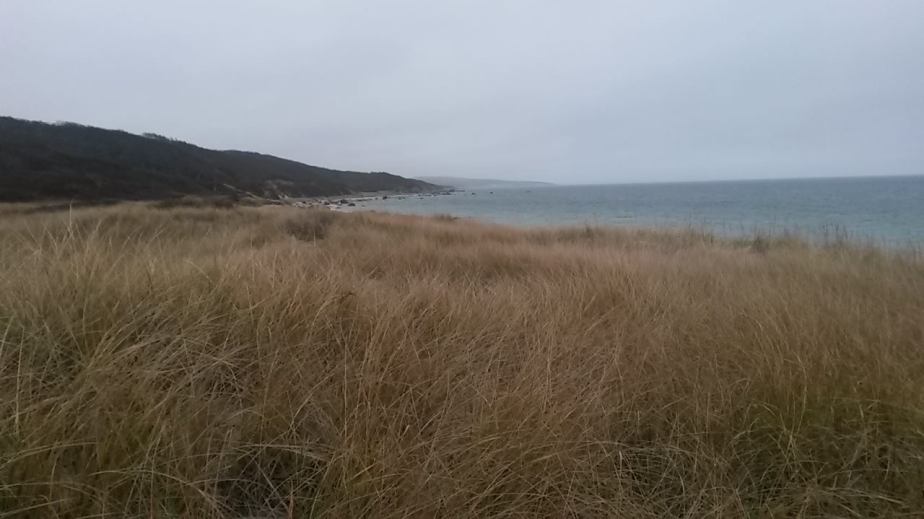
This past weekend I spent time on Martha’s Vineyard visiting my best friend and her mother. Saturday afternoon, after eating a delicious lunch, we braced ourselves for the chilly rain as we entered the Cedar Tree Neck Sanctuary to go on a hike/nature walk. We drove down a long winding dirt road off of a back area of the Vineyard in West Tisbury. After just a few minutes we arrived at a wide, dirt parking lot. There was a large map and a stack of pamphlets at the trail head. Though the protected wilderness area was extensive, the different walking paths all connected, which made it very hard for visitors to get lost.
Our trek led us over two small bridges that had purposefully uneven boards. At first glimpse the bridges seemed like they could easily collapse, but upon walking over them I realized that this was part of the aesthetic and that they were actually quite sturdy. The trail we took was the Bruce Irons Path. The first part of the loop was well-marked. The actual path was covered in leaves, as we were surrounded by barren trees, but the narrow walking area was pretty distinct. I must admit that the leaves hid the rocks and roots so there was a good amount of tripping that ensued. It was fun to frolic through the leaves though. Each prance was most certainly worth the follow-up stumble.
 Martha’s Vineyard is a great island full of beautiful scenery and wildlife, but it attracts a lot of tourists during the summer months. It’s a high profile spot for presidents both past and present so it can get a lot of intriguing press. This brings about the danger of developers who have the power to buy land, destroy wilderness areas, and build houses or stores in their place. So in the 1960’s, when Martha’s Vineyard was beginning to gain fame with the Kennedy family retreating there for the summers, a movement to turn a large amount of wilderness into conservation land began. Henry Beetle Hough and Allen H. Morgan, high profile names in Massachusetts at the time, fund-raised to buy 100 acres of land from the Daggett family. This caused a snowball effect that led to people donating an upwards amount of 400 acres of family land to the conservation fund. Eventually it was named the Cedar Tree Neck Sanctuary. To this day, all 400 acres remain intact and preserved. Therefore, walking this area isn’t just about the current experience, it’s about the history that made the walk possible.
Before we reached our halfway point, we heard the crashing waves of the ocean. Soon, the 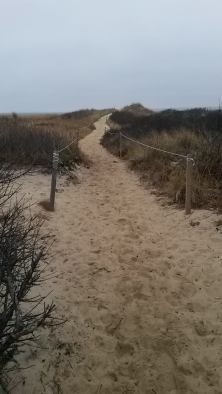 trees receded, giving way to a sea of beach grass. Leaving the tree coverage meant exposing ourselves to the rain, but it also meant a beautiful walk along the shoreline. So we trudged through the sand to climb over a dune and land on the beach. There’s a different vibe one gets when walking the beach in the winter as apposed to walking it during the summer. It’s completely empty, it’s cold, and the colors are dimmed. But that doesn’t necessary lead to somber feelings. As I walked along the beach, climbing over rocks and gazing out into the ocean’s horizon, I felt serene. I think when you go to the beach in the summer, it can be more about the ‘self’ than anything. It’s about how you look in a bathing suite, getting a tan, playing in the water, or just relaxing. That’s fine, it’s what most equate with their beach experiences, but when you go in the winter, it is less about you and more about what’s around you. You pay more attention to the beauty of the water or the beauty of the different types of rocks that you find in the sand. There is no laying out and staying put. Instead, you walk around to discover the different gifts that the ocean provides when it greets the shore. So we walked along the shore line exploring a part of the world that passionate people in the 1960’s fought so hard to protect.
Eventually our path led us back into the woods to continue the loop. Soon we ended up in a bird sanctuary that was all but empty except for a single red-tailed hawk that screeched overhead. There were hills in this area, which were made slippery by the rain, but we all kept our footing. The cedar trees that surrounded us had wild, untamed branches that reached out to welcome us. There weren’t many markings on this part of the trail, but that was okay because every fork eventually merged back together. It was almost like the different paths mimicked the relationship between the ocean and the shore. As the ocean constantly kissed then receded from the shore, the paths constantly came in contact only to divide again. But each time they separated, there was no doubt that the paths would return to greet one another again, just like there is no doubt that the ocean will return to kiss the shore once more.
Finally, we made it back to the car and hopped in. Our shoes were dirty and and our coats damp, but our smiles were full and our hearts content. I had been to the Vineyard multiple times, but this was my first time in Cedar Tree Neck Sanctuary and I would definitely recommend it, rain or shine.
 Memoirs From The Trails